
Stop caging your AI
The data says people use AI to think. Corporate strategy says automate. The value is in decision-making - your people already see that...

The latest Microsoft Work Trends Index analysed 100,000 Copilot chats from 10,000 users across 10 countries in a single week of February 2026. It looked at intent: what was each interaction for?
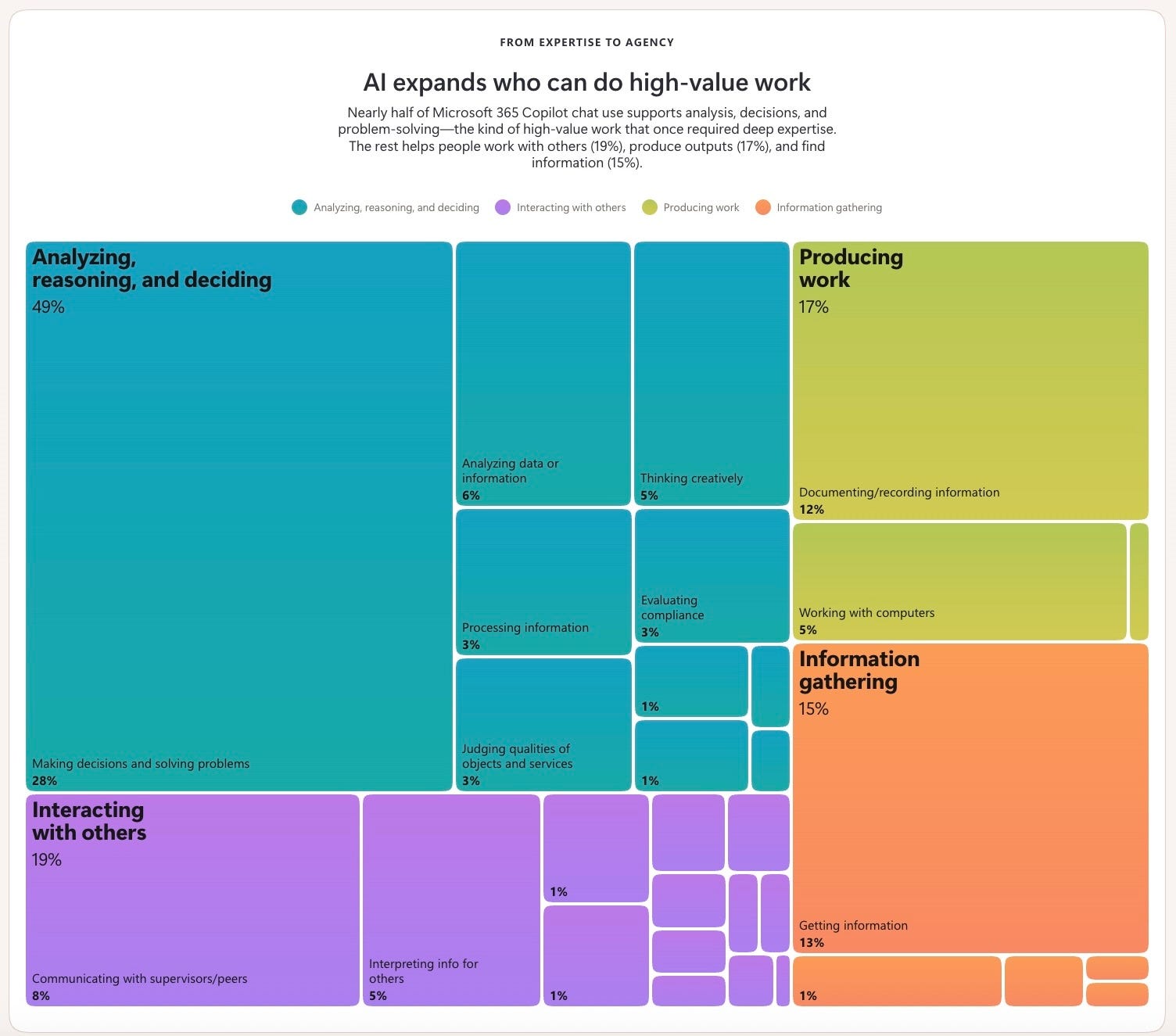
Contrast this with the consensus view - AI for business is about automation, replacing junior staff and cost cutting. Entry-level data and analysis tasks are invisible on the chart. Executing defined tasks of any kind barely registers.
The title sums this up: “AI expands who can do high-value work.” No mention of the destruction of entry-level roles. Far from replacing junior staff, AI lets less experienced people do much more advanced work.
Why are people choosing to use AI this way? AI is a probabilistic technology. It is best at answering questions with no single right answer. Decision making is full of that kind of question. So people are using AI for what it does best. Why not?
Despite widespread adoption and heavy corporate investment, many businesses struggle to see ROI from their AI programmes. Those programmes focus on tightly defined pilots, caging and controlling a technology designed for openness and exploration.
That world is full of “human in the loop.” Everything is stuffed with checkpoints and validation aimed at building trust and finding efficiencies, not showing value.
The incentives are all wrong. The objective is internal and poorly defined. Both the work and the outcome are perfectly designed to turn people off. No wonder employees are resisting AI.
Yet the key to value is already visible. The Microsoft data shows your people have already made that leap. They are motivated enough to use it this way despite corporate pressure pushing in the opposite direction.
And look around the decision-making core. The supporting use cases are about analysing, reasoning and thinking. Technology was already good at gathering vast amounts of data, long before AI came along. AI is helping people use that data to generate and evaluate more options and ideas. That is how you get to better decisions.
Learning to use AI to make better decisions harnesses the change already under way. It will help you deliver more value from your team and from AI. That value will compound, each marginally better choice building on the previous improvements.
The leadership challenge becomes: How can you turn better decisions by individuals into higher performance teams and then deliver that value to your customers? That means leadership should focus on questions of organisation and culture, not on the minutiae of automating low-level tasks. That is exactly the role of leaders and managers.
While I agree entirely with the conclusion, I am wondering if there is some confirmation bias affect happening here. Are the juniors and "low-level" staff granted access to Copilot? Could the lack of basic data input in the chart be due to enterprises only allowing access to senior people.